
Hip stability after total hip arthroplasty
A calibrated computational model quantifies how the hip capsule and surrounding muscles contribute to passive stability and examines the effect of implant alignment in positions associated with dislocation.
Postdoctoral Fellow · Center for Orthopaedic Biomechanics, University of Denver
My research in computational orthopaedic biomechanics explores how patient anatomy, soft tissues, and surgical decisions shape joint function after surgery. Recent studies examine how the hip capsule and surrounding muscles help resist dislocation after total hip replacement. CT-based virtual implantation maps the range of femoral head positions achievable with different stem and head combinations to inform implant selection and patient-specific surgical planning.
This work spans the hip, knee, and spine, combining computational modeling with experimental validation. Collaborations with clinicians and industry partners bring these methods to questions about implant performance, fixation, and the design and testing of new devices.
2026 William H. Harris, MD Award · ORS official page · 2026 snapshot
A calibrated computational model quantifies how the hip capsule and surrounding muscles contribute to passive stability and examines the effect of implant alignment in positions associated with dislocation.
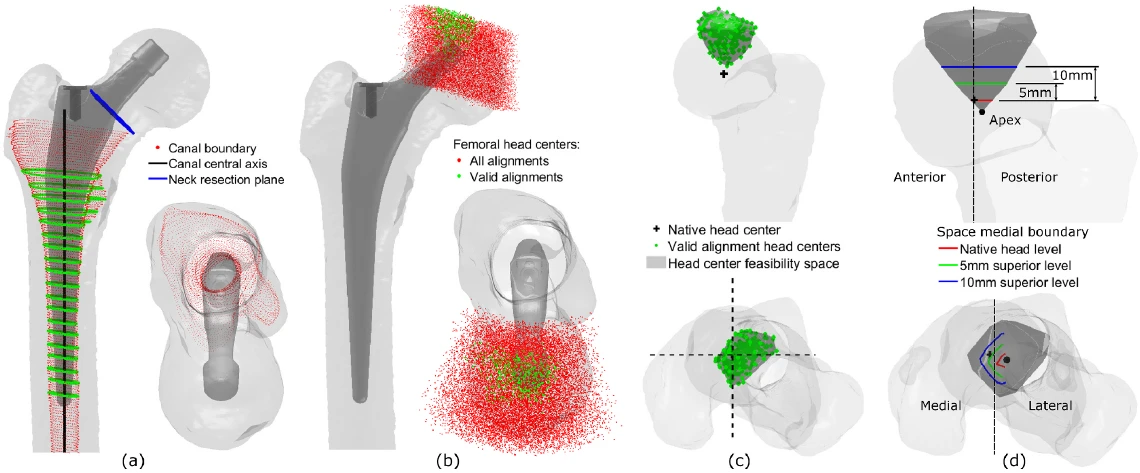
A validated CT-based algorithm maps achievable femoral stem positions in total hip arthroplasty to quantify surgeon control and support patient-specific stem selection.

Experimentally validated finite element models estimate micromotion at the bone–implant interface to assess initial fixation after hip and knee arthroplasty.
A cervical spine model supports biomechanical performance testing of existing devices and evaluation of new implant designs during development.
Virtual implantation compares coverage across femoral stem designs and quantifies the range of stem positions surgeons can achieve with each design.
A lower-limb model compares knee kinematics, ligament elongation, and ligament forces across medial-pivot implant designs.