Virtual Implantation for Femoral Stem Selection
Background
Restoring the femoral head center and offset is an important goal in total hip replacement. A surgeon may plan for a target position, but the patient's femoral anatomy and the selected implant constrain which positions are achievable.
Methods
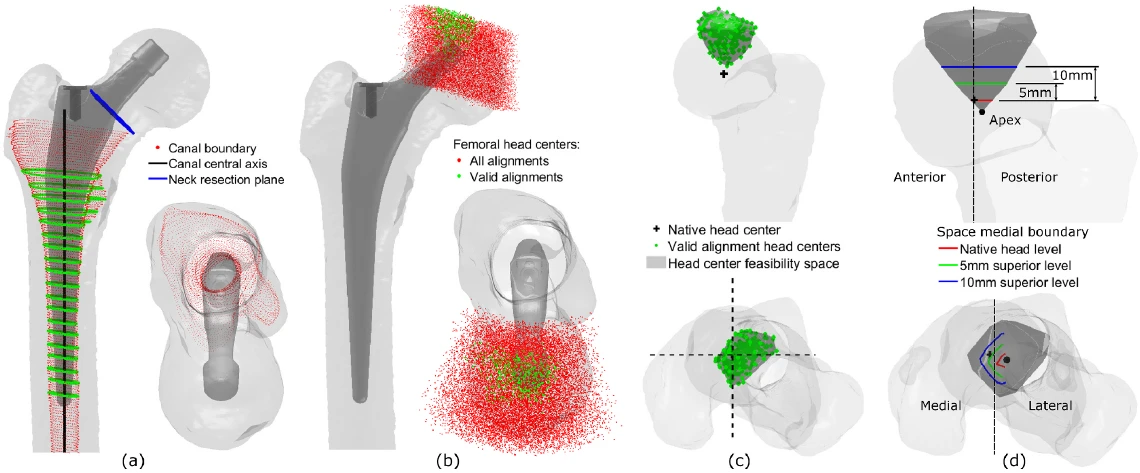
A CT-based algorithm segmented the femoral canal and simulated valid three-dimensional stem alignments across component sizes. The method was evaluated in 16 cadaveric hips by comparing actual surgical placements, measured from postoperative scans, with the closest matching virtual placements.
Key Findings
- Predicted femoral head centers matched the experimental placements within 1.9 ± 0.5 mm on average.
- For each specimen, at least one stem–head combination could position the head center within 5 mm of its native location.
- The achievable range was larger in the anterior–posterior direction than in the medial–lateral direction. Both ranges expanded with more superior stem seating.
Significance
Mapping a range of achievable positions shows how much control different stem–head combinations offer for a given patient. This can inform preoperative planning and provide a common basis for comparing implant designs.
Related Publications
-
Validation of a virtual implantation algorithm to quantify surgeon control and optimize stem selection in total hip arthroplasty
Yang H, Han X, Mattei S, Rajpura A, Board TN, Myers CA, Rullkoetter PJ, Clary CW.
Journal of Biomechanics, 205, 113422 (2026).