Validating Finite Element Models of Cementless Knee Fixation
Background
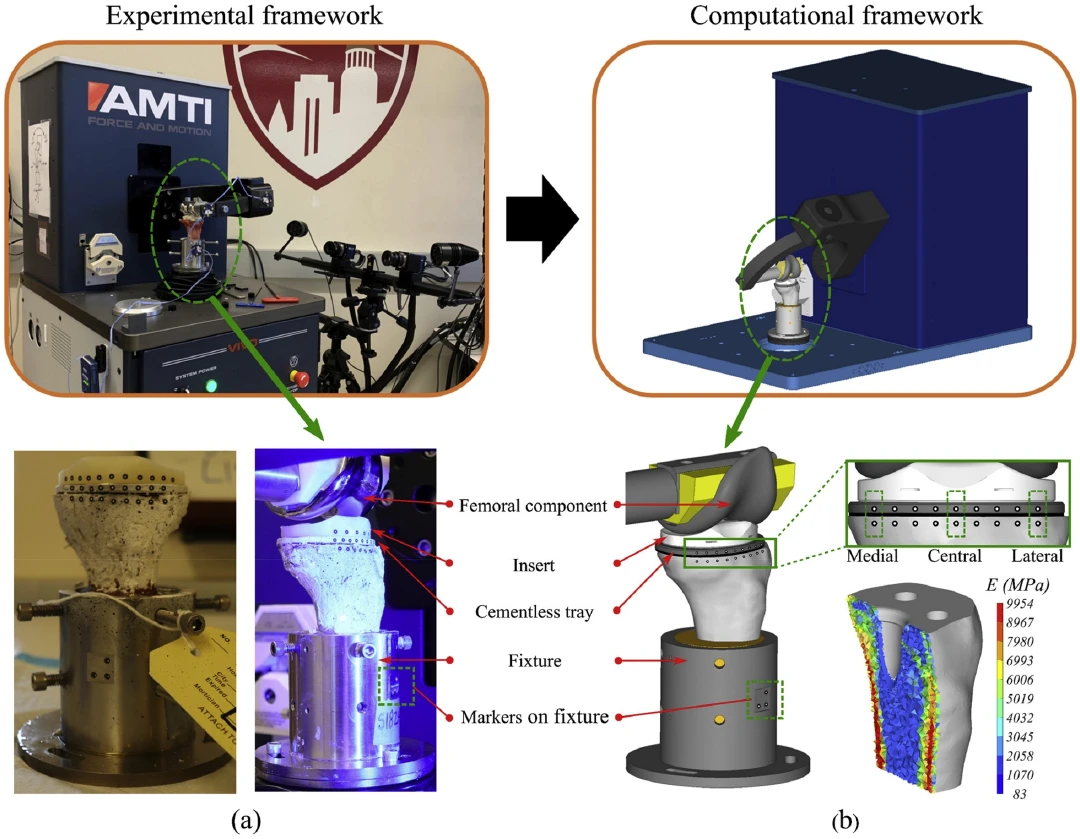
Small movements where the tibial tray meets bone can affect cementless fixation. Direct measurements across the full contact surface are difficult, so validated models can help estimate where and when micromotion occurs.
Methods
Three cadaveric knees with cementless rotating-platform implants were tested under gait, deep knee bending, and stair descent loads. Subject-specific models were validated using the relative movement of tray and bone markers and tibial surface displacement measurements.
Key Findings
- For marker relative displacements, the best-matching models had an average root-mean-square error of 13.1 µm and a correlation of 0.86.
- Markers around the tray underestimated the predicted micromotion across the full interface.
- Small changes in initial tray alignment affected the magnitude and distribution of interface micromotion.
Significance
The validated framework supports preclinical comparison of implant designs and helps interpret what experimental marker measurements reveal about fixation.
Related Publications
Validation and Sensitivity of Model-Predicted Proximal Tibial Displacement and Tray Micromotion in Cementless Total Knee Arthroplasty Under Physiological Loading Conditions
Yang H, Bayoglu R, Sharifi Renani M, Behnam Y, Navacchia A, Clary CW, Rullkoetter PJ.
Journal of the Mechanical Behavior of Biomedical Materials, 109, 103793 (2020).