Bone Strain After Cemented Knee Replacement
Background
Bone remodels in response to mechanical loading. After cemented knee replacement, changes in load transfer can change strain energy density in the proximal tibia, a mechanical stimulus for remodeling.
Methods
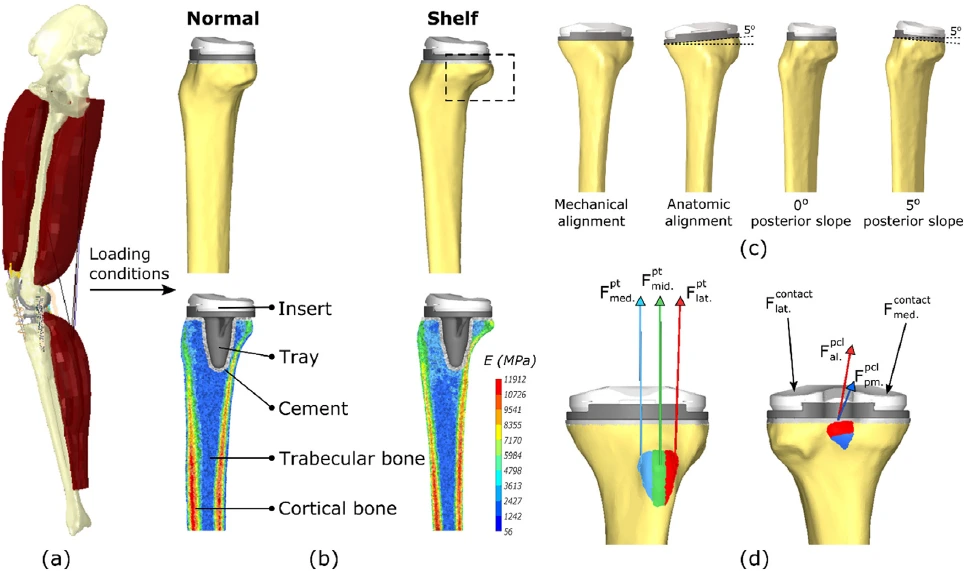
Finite element models of two tibiae varied tray material, alignment, posterior slope, and posterior cruciate ligament balance. The models compared proximal tibial strain energy density at peak loading during gait, deep knee bending, and stair descent.
Key Findings
- Tibial anatomy had the largest effect, followed by ligament balance, surgical alignment, and posterior slope.
- The remaining cortical wall thickness helped explain differences between the two tibiae.
- Lowering the tibial tray material stiffness produced comparatively small changes in the predicted strain response.
Significance
The results help prioritize patient anatomy and surgical factors when interpreting postoperative load transfer. The models estimated mechanical stimuli for remodeling, rather than measuring remodeling directly.
Related Publications
Impact of Surgical Alignment, Tray Material, PCL Condition, and Patient Anatomy on Tibial Strains After TKA
Yang H, Bayoglu R, Clary CW, Rullkoetter PJ.
Medical Engineering & Physics, 88, 69–77 (2021).