What Affects Micromotion in Cementless Knee Replacement?
2020–2022 · Total knee arthroplasty
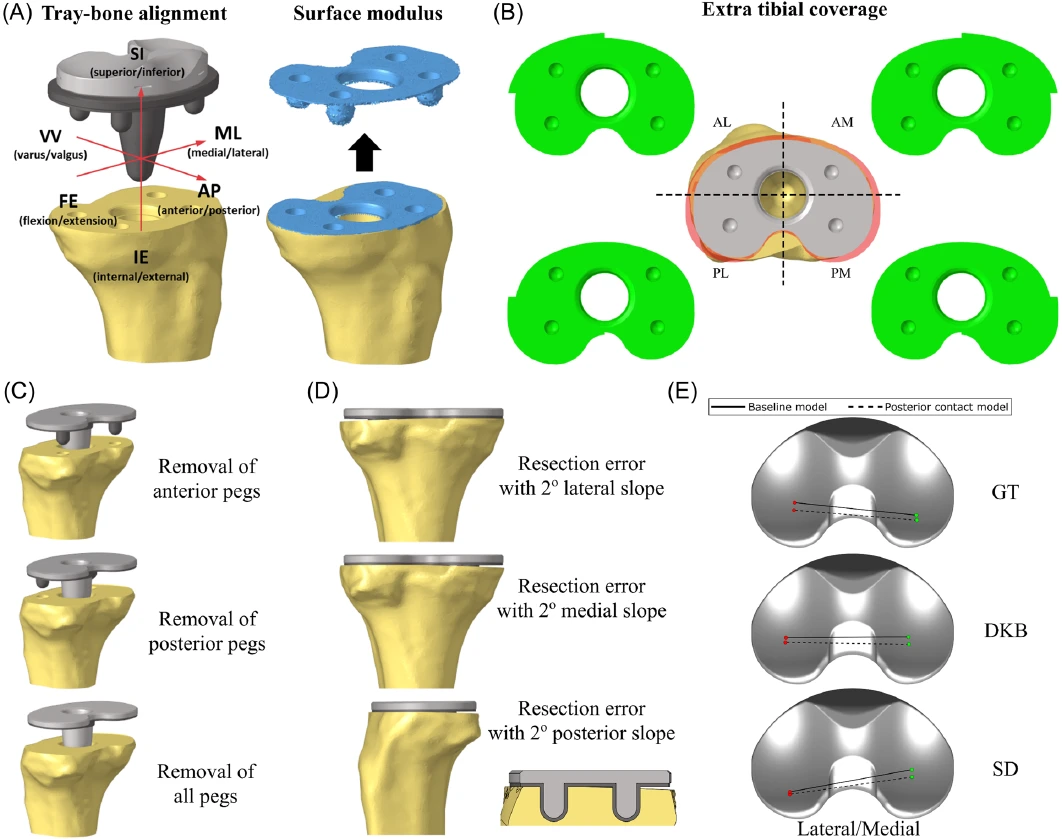
Variations in component placement and model parameters used for sensitivity testing (Yang et al., 2023, Fig. 2).
Background
Stable initial fixation is important for bone ingrowth around the tibial tray. A surgeon can adjust alignment and bone preparation, while bone properties and knee kinematics vary across patients.
Methods
Three previously validated finite element models simulated gait, deep knee bending, and stair descent. Surgical factors, patient factors, and design factors were varied to compare relative motion across the cementless tray–bone interface.
Key Findings
Predicted average interface micromotion ranged from 9.3 to 111.4 µm, with peak motion consistently found at the anterior tray edge.
A 1 mm anterior tray shift lowered average micromotion by 16.1%, while increasing coverage beyond a properly sized tray had little effect.
A 2° resection error reduced the area favorable for bone ingrowth by up to 48.1% in the simulations.
Significance
The results show why resection accuracy and the location of joint load transfer matter when assessing initial tibial tray fixation.