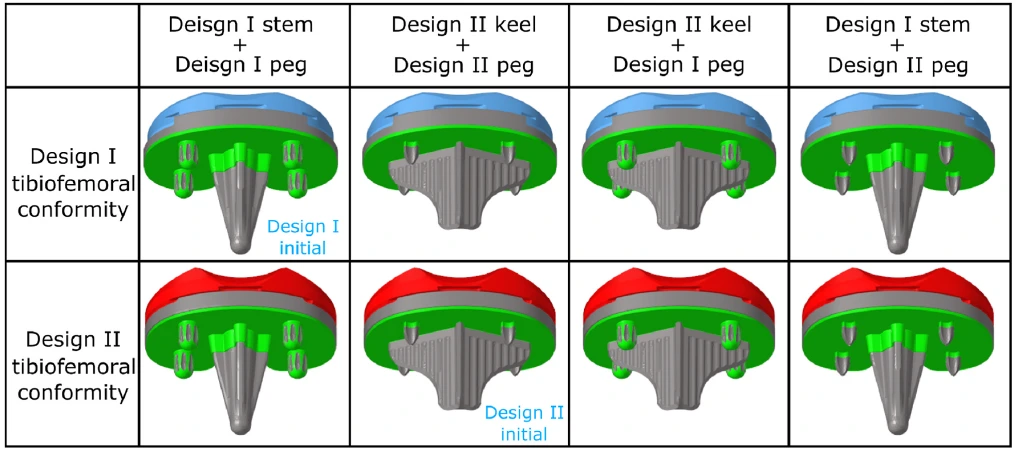
Eight modeled combinations of bearing conformity and tibial fixation features (Yang et al., 2022, Fig. 3).
Background
Cementless tibial tray designs differ in both bearing geometry and fixation features such as keels and pegs. Comparing complete implants makes it difficult to see which features drive differences in initial stability.
Methods
Experimental tests and corresponding computational models compared two total knee designs under simulated daily activities. The models exchanged bearing and fixation features to estimate the contribution of each to tray–bone micromotion.
Key Findings
Predicted peak interface micromotion differed by at least 47% between the two designs.
In the modeled comparison, bearing conformity accounted for 79% of the difference in micromotion and fixation features for 21%.
More posterior bearing contact increased predicted micromotion and reduced the area favorable for bone ingrowth.
Significance
The way a bearing transmits load across the tibial tray can influence fixation as much as the features anchoring the tray. The two design choices can be evaluated together.