Implant Placement in Cervical Disc Arthroplasty
Background
Cervical disc replacement aims to preserve motion at the treated level. Small changes in implant placement can alter how load is transferred through the implant and facet joints, even when the spine moves through a similar range.
Methods
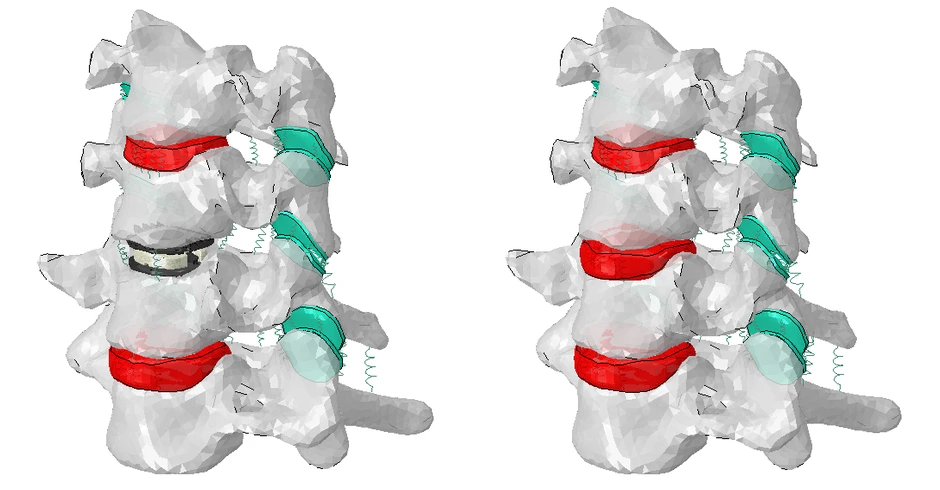
A C4–C7 finite element model compared semi-constrained and fixed-core devices at C5–C6 under matched overall cervical motion. Placement was varied by up to 2 mm anteriorly or posteriorly and 1 mm medially or laterally. Outcomes included segmental motion, facet loading, and implant contact pressure.
Key Findings
- The two designs generally showed comparable changes in motion at the treated and adjacent levels.
- The semi-constrained design generally produced facet forces closer to the native model and spread implant contact over a broader region.
- The fixed-core design showed more localized contact pressure in several anterior–posterior placement conditions.
Significance
Range of motion alone may miss changes in load sharing. Testing both motion and contact can help evaluate how sensitive a cervical disc design is to placement variation.
Related Publications
Impact of Suboptimal Placement on Disc Arthroplasty Mechanics for Semi-Constrained and Fixed-Core Devices: A Finite Element Study
Yang H, Kim KD, Rullkoetter PJ.
54th CSRS Annual Meeting, Austin, TX (2026). Scheduled presentation by Kee D. Kim, MD.